Welcome to Joe Norris Playbuilding

The book, Playbuilding, “not only met all the criteria for the [2011, Qualitative Research SIG, AERA] Outstanding Book Award, it exceeded every criteria. Norris bridges arts-based research, qualitative research, and playbuilding grounded in rich theories and create dialogue for various social justice issues. The committee members exclaimed not only about the accessibility, utility of this book, but the ways in which this book challenged our thinking, made us imagine how the audience participation might look like at the end of the scenes and the fertile ground for much needed dialoguing…. Congratulations Joe”

Qualitative Research SIG, American Educational Research Association

For more information about Playbuilding as Qualitative Research: A Participatory Arts-based Approach go to: http://www.lcoastpress.com/book.php?id=278

Scroll down for a listing of Mirror Theatre performances and click on the images to be directed to the research videos.

Note that while videos are being updated weekly, the complete repertoire will take until September, 2012 to complete.

Playbuilding as Qualitative Research

This book is for both art-based researchers and research-informed artists, exploring the theatrical genre known as Collective Creation, or Playbuilding. Performers generate data around chosen topics from addiction and sexuality to qualitative research by compiling scenes from their disparate voices. Audience members become involved in the investigation, and the performed scenes do not end the conversation but challenge and extend it. Through discussion and audience participation, the process examines how knowledge is defined and how data is mediated.


Chapter 1 provides a rationale for playbuilding as a qualitative research genre; Chapter 2 describes the research methodology and Chapter 3 provides the history of Mirror Theatre in Alberta over a 10 year period. Chapters 4 through 14 are scripts from performances with both a thematic and theatrical analysis. Chapter 15 concludes the book with a discuss of how the ‘joker’ may facilitate audience discussion. Below is a list of scenes and their content:


Scene

Theme

Dramatic Forms Used

Source Play

4

“Pressures”

Peer pressure

Sculpting & readers theatre

What’s the Fine Line?

5

“The M Word”

Sexuality

Improvisation, testimonials

Complexities & Contradictions

6

“Funky Shirt”

Gender politics/clothing

Voice-overs

What’s the Fine Line?

7

“Cattle Call”

Body image

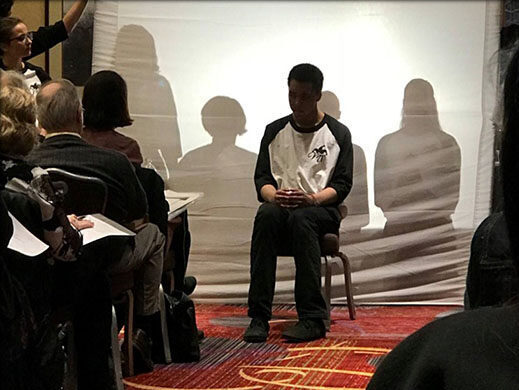
Shadow screen

One of These Things

8

“Great Expectations”

Student teaching

Voice collage

Great Expectations

9

“The Party”

Status

Gibberish

Coulda/Shoulda

10

“Dares”

Substance abuse

Surrealistic drama

Last Call Your Call

11

“Are You Really Listening?”

Alienation/judging others

Inner dialogue

Understanding Prejudice

12

“Who’s with Whom?”

Prejudice

Mime

Understanding Prejudice

13

“Whose Pencil Is It Anyway?”

Dealing with conflict

Realistic scene

problem plays

Fair Play Rulz

14

“Distillation”

Qualitative research

Machines & metaphors

ReSearch RePlay

4.321: You be the Judge

Source:
http://www.flickr.com/photos/gforsythe/6860540818/

Topic: Judging/Assessing/Grading
Date:
March, 2012
Venue:
Centre for Pedagogical Innovation, Brock University
Description:
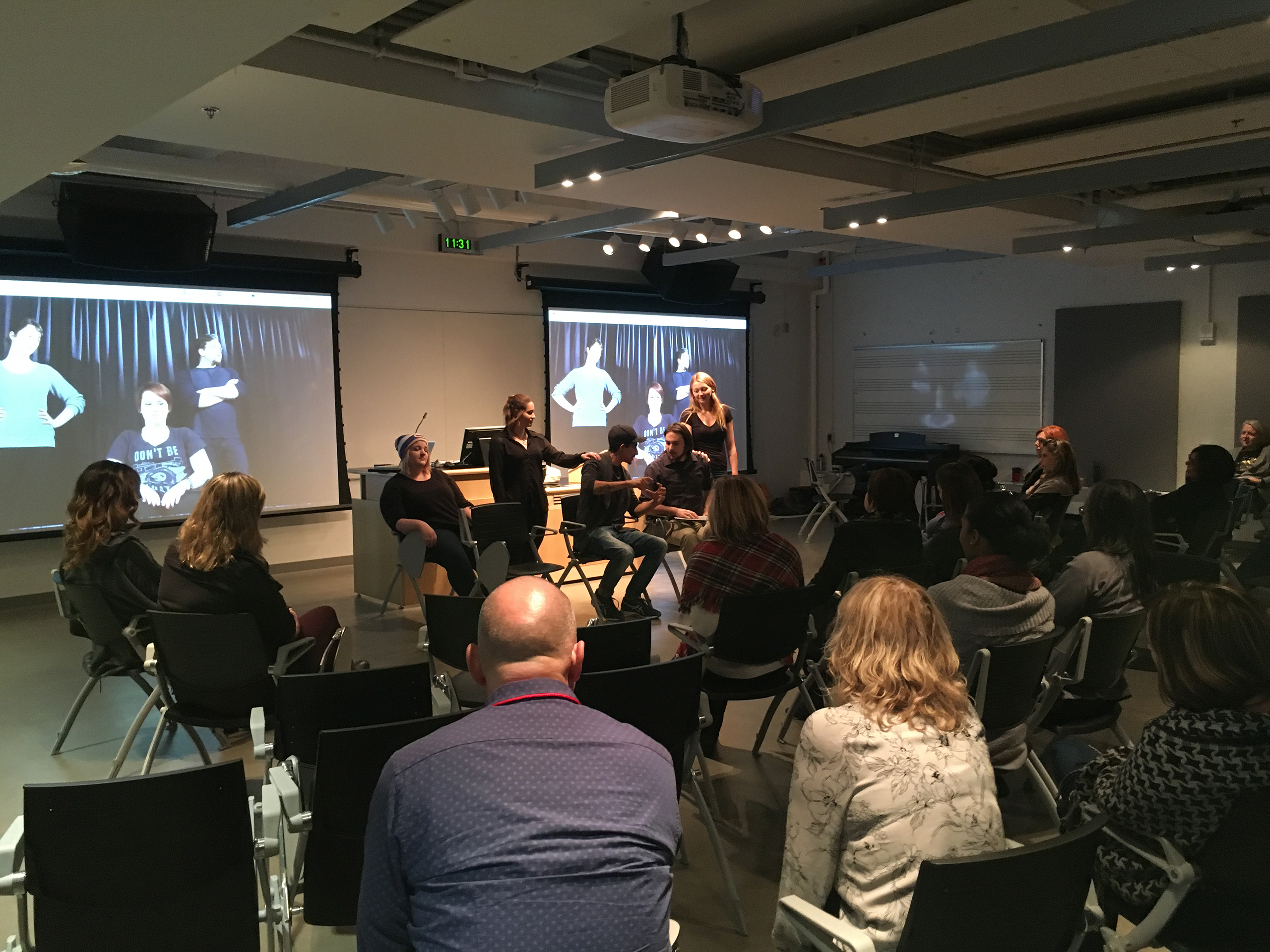
Assessment is a pervasive activity in our daily lives. But like the air we breathe, it almost goes unnoticed. 4.321: You be the Judge provides a small portrait of the  interpersonal dimensions of assessment exploring how our species has a propensity to judge and compare one another. Such acts can include/exclude, demean/affirm and exalt/harm and must be continually questioned to insure justice and equity.  The cast has researched many aspects of this behemoth and has compiled a collage of vignettes to begin to describe how this behavior is played out in both formally and informally in all that we do?
          We ask, Why do we judge/assess? Are all assessments necessary, appropriate and/or fair? What are legitimate criteria? Can one separate the product for the producer, the intellect from the affect? Can and how should accommodations be made and for what reasons? How does assessment foster and/or impede learning?
          The vignettes provide just a few of the many lived-experiences of how we live under the specter of the judge and how we play the role of the judge. They don’t provide you with answers. Rather, we hope that they haunt you, encouraging you to examine how we can put a human face to these practices. We’ve only begun to scratch the surface… so we ask, “you be the judge”.
          Audience responses after the performance workshop included: “that was a great awakening” and “it really opened my eyes”.

Common Knowledge

Topic: Academic Integrity
Date: November 2011
Venue:International Centre for Academic Integrity Conference
Date: February, 2012
Venue: Centre for Pedagogical Innovation – Teaching Assistants  Workshop
Description: What leads people to cheat? What personal, interpersonal and systemic factors are at play? Based upon personal and external research, Common Knowledge provides a variety of examples of how academic integrity issues are play out on campus.  Confusion abounds as first year students are expected to quickly learn a lot of insider knowledge that is common place to those well versed in the academic culture. Determining what is common knowledge, how to cite, and generally learning the system are the easy(?) technical issues to navigate. The decisions to plagiarize, hire ghost writers, and cheat during exams, among others,  are underpinned by issues of fairness, integrity, authenticity and justice.
          The above are just a few of the themes the have emerged that are embedded in the performed vignettes . The scenes examine moments of decision, dealing with the consequences and the effects on others beyond self.  The larger underlying question is, “What can educational institutions do to create learning environments in which all parties move beyond the mechanics of assessment and accreditation to the intrinsic and altruistic purposes of learning for the betterment of self an others?” We also ask,  “Whose responsibility is it?” and challenge audiences and our selves to find ways to move away from an “I/It teaching/learning relationship to an I/Thou one (Buber, 1987) in which all parties act with integrity toward one another.

Ball and Chain

Topic: Mental Health in the Workplace
Date:
November, 2011
Venue: Brock Supervisors’ Fall Training Conference
Description: Ball and Chain … MORE TO Come…

Escalations


Topic: Violence in the Workplace (Ontario Bill 168)
Date: November, 2011
Venue: Professional Development for the Employment Help Centre (Beamsville)
Description: Escalations examines… MORE TO Come…

DisPositions

Topic: Power in Professor/Teaching Assistant/Student Relationship
Date: April, 2011
Venue: Brock Annual Symposium on Academic Risk
Date: September 2011
Venue: Centre for Pedagogical Innovation – Teaching Assistants  Workshop
Description: Dispositions examines… MORE TO Come…

What Lies Beneath

Topic: Violence on Campus (Ontario Bill 168)
Date: November 2010
Venue: R.A.M.P. it up for Safety” Supervisors’ Conference, Brock University
Description: What Lies Beneath examines… MORE TO Come…

(Re)Productions

Topic: Prolife/Prochoice Conflicts
Date: January, 2010
Venue: Brock Center for Woman’s Studies
Description: (Re)Productions examines… MORE TO Come…